
Part 2 of a 3 Part Series on the Duality of Raising Animals
Many people struggle to reconcile how producers can devote so much time and care to raising their animals, only to ultimately facilitate the end of their lives. To better understand this tension, bridge the gap between the field and the table, and offer a fuller picture of the food system, we spoke with three producers about the duality of raising animals for meat; The labor, the emotions, and the responsibility it carries. Their stories reveal why the way animals are raised and processed matters, and why choosing your food (and who raises it) with intention makes all the difference.
When Carla Nordlund acquired her first pigs, starting a hog farm was not the plan.
“I very randomly bought two feeder pigs off of Craigslist that were supposedly half Meishan,” she recounted. Little did Carla know that these pigs would be a catalyst.
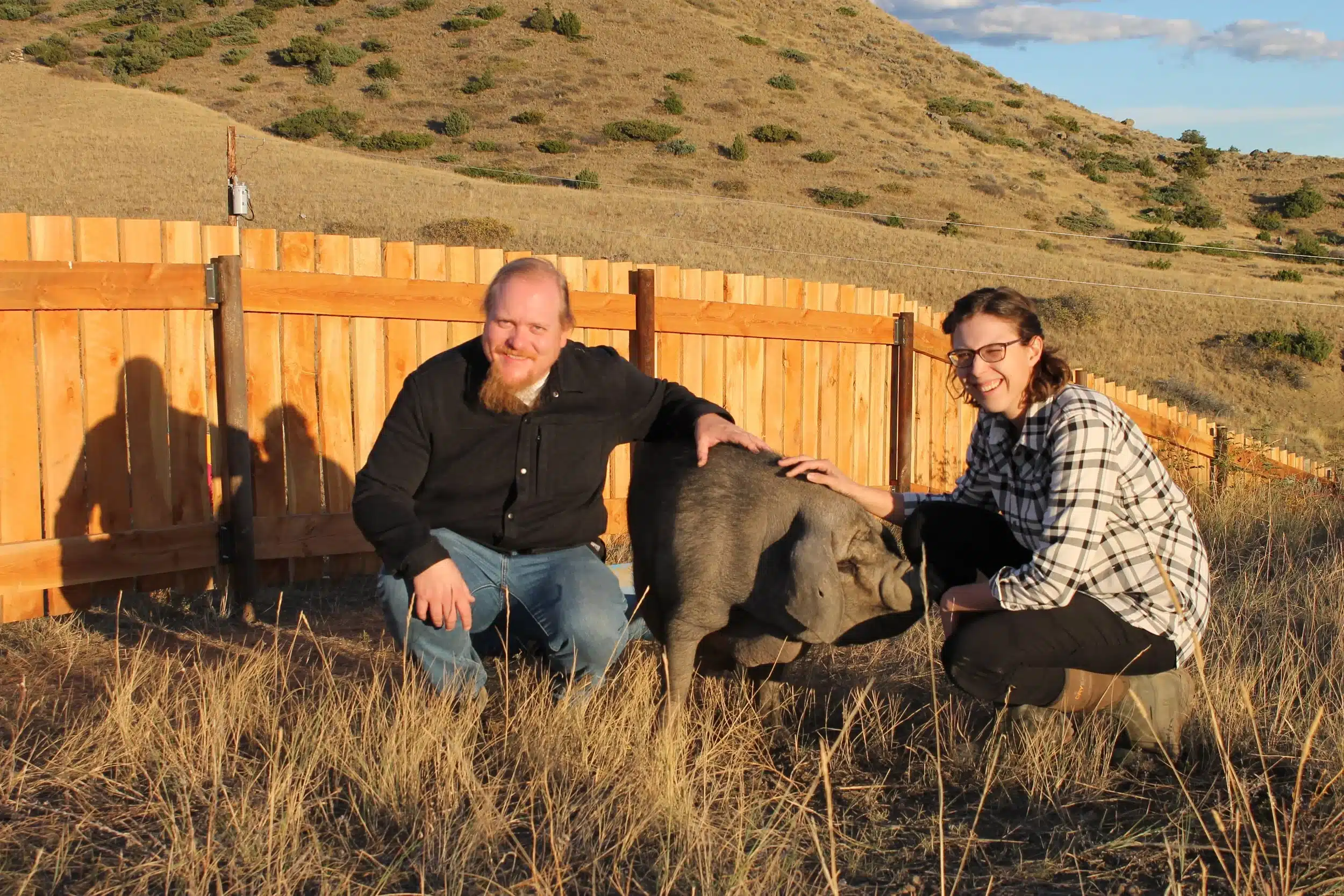
While Carla and her husband Ben weren’t new to raising animals, these pigs were something special. In 2024, the Nordlunds launched Jackstone Creek Farmstead, offering sustainable pasture-raised, corn and soy-free, Meishan pork.
As we continue our series exploring the duality of raising animals, you might be asking how farmers and ranchers can raise animals for slaughter, especially when they believe they’re something special.
For the Nordlunds, the answer is simple: conservation.

“By finding a market for this breed, by seeing the whole life cycle, by maintaining our breeding herd, all of this, even though it may take the lives of individual animals, it’s part of this greater effort that is actually keeping this breed going,” says Carla. “Without a market outlet, without a job, a use, the breed won’t survive.”
Meishans are a critically endangered heritage breed. And when Carla and Ben started their production, there were no registered Meishan pigs in Montana. Originally from China, the breed was developed around 5,000 years ago. Despite this long history, in the last 100 years, their numbers have plummeted.
“They did not adapt well to factory farming in China or the U.S. or basically everywhere they’ve been exported to,” said Carla, “They have a lot of really wonderful qualities, and being able to deal with the stress of factory farming is not one of them, which is a good thing ultimately.”
Far removed from factory farming, the pigs at Jackstone Creek are thriving. The herd is hand-fed with fermented grains and rotationally pastured. During the breeding season, sows (mama pigs) have access to the outdoors, unlike conventional methods where they’re kept confined in a crate. In summary, Carla and Ben allow space for the herd to behave as they would in the wild.
Still, Carla and Ben spend a significant amount of time with the herd on a day-to-day basis, making sure they’re happy and healthy.
“You get to know individuals, taking them from farrow to finish…They all have their own personalities that you get to know. It’s a different relationship from having pets, I would say. But you’re still working so hard to care for them day in and day out.”


Carla doesn’t avoid the complexity this care brings to their end goal of processing; she embraces it.
“I think it should feel complicated and messy, emotions-wise, which is how I feel driving to the processor. There’s grief, there’s pride, there’s relief, there’s sadness, there’s gratefulness. It’s just this mix of emotions, and I don’t think we should shy away from that. I know this is going to be different for every person, but for me, if I ever feel numb about this, something is wrong.”
For the Nordlunds to sell directly to consumers, they must have their meat processed at a USDA facility, which are few and far between in Montana.
“I’ll be frank, it is a bottleneck. Scheduling’s been difficult,” says Carla. Even with their smaller herd numbers, there’s not always availability at their preferred processing facility.
Across the country, the number of meat processors has dwindled due to the inability to compete with the “Big Four” of meat companies (JBS, Tyson Foods, Cargill, and Smithfield) that dominate the industry, creating a shortage of both small-scale processors and butchery knowledge. While the industry is beginning to grow again, especially with cooperative, community-driven solutions like Old Salt Co-op, The Producer Partnership, and the Montana Premium Processing Cooperative (MPPC), Montana still only has 39 USDA-certified meat processors, forcing ranchers to schedule months or even years in advance.
But even in death, Carla and Ben want quality care for their herd. They consider how to keep the process low-stress for the animals, which processors use humane and calm handling techniques, as well as how they can honor the animal’s life by using as much of it as possible.

“How do we do a whole-carcass butcher? How do we utilize organs, and bones, and ears? If we’re going to do this weighty, heavy thing, we’re going to make sure to honor that sacrifice a little bit, and actually put it to use,” says Carla. “How can we make it meaningful on both ends, when they’re alive, and after they’re processed?”
With all these considerations, finding the right processor is a work in progress. “I don’t think we’ve quite found something that’s fully set up for what we have in mind, which is no fault of their own. Currently, we’ve probably stayed within 100 miles or less to haul for processing. And we’re starting to shoot a little bit wider just to see what our options are,” says Carla.
To find someone who ticks all the boxes, they may have to sacrifice in some areas.
“It’s a hard decision trying to balance. You want to do everything right. And some of it kind of comes into conflict with each other.”
Juggling the physical labor, the mental load of decision-making and the weighty emotions can take a toll. “There’s days that we joke that the pigs and probably our customers eat better than we do. ‘Cause we’ve worked 10 hours, and then put in frozen pizza,” laughed Carla.
In the end, what makes it all bearable is the care—for the Meishans and for their neighbors.
“We would not be doing this if we were in a traditional confinement barn going into a commodity market. There is no joy or purpose I see in that. I think it really makes it all worth it, knowing we provided the best lives we could for these pigs. They are now nourishing people that we know that are close by. We’re minimizing the harm to everyone, to people, to the pigs; there’s less food miles,” states Carla. “If we are going to eat meat, this is about the only sustainable, ethical way I can see of doing it, which is to change the food system, which is a huge beast.”
Perhaps the clearest impact of making this change can be seen in the Nordlunds’ two young daughters. Raised fully with eyes wide open, they don’t struggle with balancing life and death.
“In some ways, it’s this big, nebulous, moral topic that I’ve been struggling to describe this whole conversation. And then also, to my five-year-old who has grown up intimately with this, I think there’s a clarity there somehow. She already understands it better than even we do. There’s a naturalness to her,” says Carla. “I think in a lot of ways, she actually holds all of that duality together a lot easier than Ben and I, who were a little bit more removed from our food cycle as kids.”
The Nordlunds involve their children in the process and answer questions as they come up, facing the complexity head-on. “We recently processed an old boar and brought him back, and she’s like, ‘So Harry’s in the freezer now, right?’ and I’m like, ‘Yep.’” says Carla. “There’s a simplicity to both things being true. It can be really nebulous, and really simple.”
The pigs are cared for. And they become food. There’s no need to resolve the tension.
“It’s kind of an ‘and’ statement,” Carla reflects. “We care for them… and then they come back and care for us.”
Join us next month for Part 3, with Jennie Becker of Stick Leg Ranch!
Photos courtesy of Jackstone Creek Farmstead
Written by:
Emilee Wood