

Part 3 of a 3 Part Series on the Duality of Raising Animals
Many people struggle to reconcile how producers can devote so much time and care to raising their animals, only to ultimately facilitate the end of their lives. To better understand this tension, bridge the gap between the field and the table, and offer a fuller picture of the food system, we spoke with three producers about the duality of raising animals for meat; The labor, the emotions, and the responsibility it carries. Their stories reveal why the way animals are raised and processed matters, and why choosing your food (and who raises it) with intention makes all the difference.
Jennie Becker is a self-proclaimed “Disney-child”, raised on fairytails, and sheltered from the reality of where her food came from. So she describes her transition from city girl to rancher as nothing short of magical, a “spiritual moment.”
“This might sound woo-woo to some people,” said Jennie, reflecting on her upbringing. Growing up, she struggled with the connection between food and death. “I’m a big baby in my heart. I gutted [a fish] once, and I just couldn’t eat it. I mean, that’s how far I’ve come, right?”
Jennie’s journey to being a rancher began in 2012 with a love story when she met her now-husband, Seth Becker. Together, they started Stick Leg Ranch. Located in Valier, Montana, Stick Leg Ranch offers pork and beef, raised on rotationally grazed, regenerative pasture.

The ranch is named after Seth, who lost his legs during an accident while working on an oil rig. As a result, he has struggled with various autoimmune disorders, health complications, and inflammation. However, the Beckers switched to a holistic diet of locally raised foods and saw a significant improvement.
“He used to ache all the time in his shoulders, and his elbows and his knees, and that has gone away, and his headaches have gone away, and mine. I could go on for days about the health benefits of eating locally — not “correctly,” correctly from my perspective — raised foods.”
Having experienced these benefits firsthand, the Beckers are passionate about helping others connect to their food.
“We encourage our customers to come pick up their meat because we want to show them,” said Jennie. She recounted stories of showing customers around the farm, and seeing the impact of health-supporting food in their lives.
“[It] really seals the deal for us, because it’s a lot of work and it is a lot of emotion and it’s a lot of things, but to feed ourselves and to feed other people who really care, that’s what just solidifies it.”
Jennie regularly shares online about life on the ranch, connecting her audience to the often-hidden parts of our food system. Some people love the transparency, while others are less supportive.
“I’ve been called all sorts of things online. I think any producer does. Like, we’re ‘horrible humans’, you know, and we ‘murder animals’, and all the things that the people that see our videos might say,” says Jennie.
However, Jennie empathizes with the emotions behind the harsh comments. “I think people that are afraid of meat, and afraid of this process, are just so removed from it that they’ve lost the sense of fulfilling the measure of the purpose of the animal.”
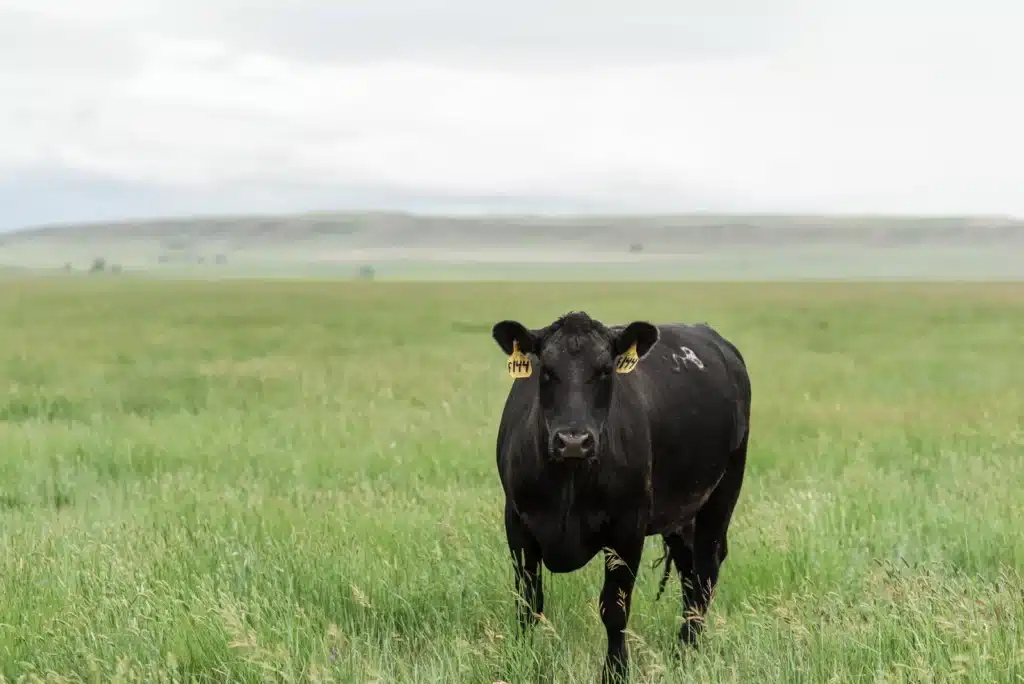
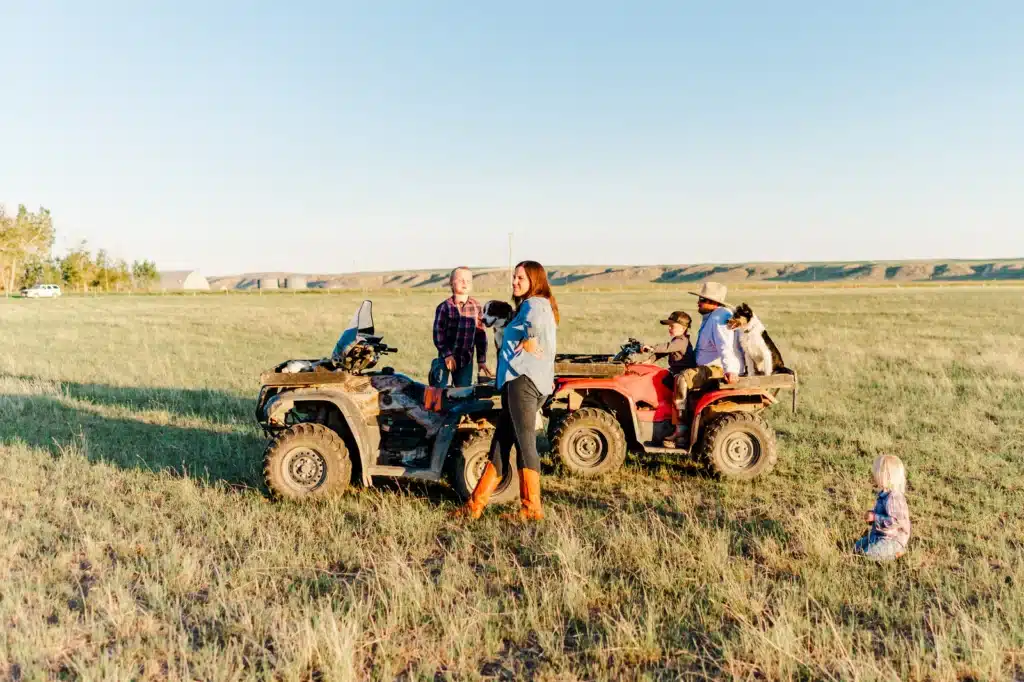

Whether curious or critical, the Beckers extend the same invitation to everyone.
“I feel like it’s a sacred responsibility to be stewarding these animals in this land, providing food for people. And I don’t shirk away from it for people that disagree with me because what I tell people that are like ‘How could you?’, I’m like, ‘Come and see,’ is what I say. ‘Come and see. Come to my farm, and just see, and you’ll know, right? I’m not afraid. Come on over.”
These connections formed with customers provide purpose for the more taxing parts of raising animals for food.
“There are some days when it’s, when what we’re doing is so hard,” says Jennie. “And I’m like, ‘why are we doing this?’ And then somebody in the community reaches out and is like, ‘I’m so grateful your guys’ meat is in this store.’ There’s such an importance of feeding, of food. I think it bonds people.”
There’s another bond that happens behind the scenes –– the bond between the animal, and the person raising it.
“You do get to know those guys a little well. They all have their funny quirks, but the sows, the breeding stock is who you get to know the most. And you know, I didn’t grow up farming and ranching, like all animals I had were pets. And so that’s been a transition to go from like, these are not pets, these are food.”

Jennie remembers one of her first lessons in this transition vividly.
“The first time we ever sent one of my sows to the butcher (she was even a rank sow; she chased me out of her pig pen, but you just get to know them so well), I cried and cried and cried, and I couldn’t eat her meat. And I donated that meat to the food bank because I was like, ‘I can’t do it. I can’t eat her.’”
For every animal processed, there are also emotions that must be processed. While Jennie has experienced various levels of loss throughout life, carrying the grief is still a work in progress.
“…Here I am 11 years in, and am I able to do it now without crying? Absolutely. But do I still feel the emotion behind all of it? Yes.”
On a good day, there are no tears. On a hard day, Jennie has learned to take a moment to mourn and recognize the hardship, taking a walk, or spending time alone. She’s recognized the rewards and difficulties of raising animals cannot be separated, rather they both have their place.
“I do think it’s sad to hear people say, ‘Oh, you’ll get used to it. You’ll feel numb to it,” says Jennie, “‘Cause I’m like, I don’t know if I ever want to feel numb to sacrificing a life for my benefit, or being numb to just even seeing any life be gone.”
Over a decade into this journey, Jennie has learned to hold the duality of life and death in our food system as necessary.
“Raising domestic animals is both a sacrifice and it is their purpose,” says Jennie. “It’s twofold. They wouldn’t be here if I wasn’t raising them for food; their purpose is to be raised to feed people.”
Like Jennie, many of us were raised without an understanding of how our food reaches our plate. While the reality of death can be hard to swallow, when we move away from “palatable” and towards “proximity”, we discover that eating can be one of the most powerful things we can do. Jennie’s story illustrates that connecting to your food can take time, but is worth the effort. Carla showed us that there’s no need to resolve the complexity of life and death, or to hide from it. Rather, as Matt taught us, when we choose to face death with eyes wide open, we get to take part in a food system that’s full of beauty, grit, and reciprocity. There’s no happier ending (or beginning) than that.
Read the Rest of the Series on our Blog!
Photos courtesy of Stick Leg Ranch
Written by:
Emilee Wood
Leave a Reply
You must be logged in to post a comment.